Showing posts with label Retro Tech. Show all posts

Thursday, November 08, 2012

Walking Into The Landscape

Landscape Study - Jim Belfiore (c) 2012
I've been fascinated with trends in computing and futurism ever since I was a little kid.  In the late 1960's, I got hooked on ideas postulated in science-fiction, particularly in hard science-fiction (where science was extrapolated as far as possible to project possible futures, as opposed to just giving in to pure fantasy).

Conventional ideas from science-fiction such as faster-than-light travel, time-travel, and immortality are just a few of many fantastic goals that, while not likely to be realized ever, drive real-world innovations.  They've certainly had impacts on my careers and side-projects over the last quarter century.  As one friend once told me a long time ago, "You're always shooting for the moon, and even if you never get there, you always seem to make it to the next mountain along the way."

Some ideas, however, seemed almost to be within reach (certainly within my lifetime), and as I've gotten older, I've never lost the sense of wonder that comes at the special moment when an idea that seemed to be an impossible element of fiction, became reality.

In particular, I've been fascinated with advances in computation, particular as applied to creativity.

If you're my age or older, then you know the old-fart stories we're telling the younger generations about the history of computers: "When I was your age, computers were as big as cities and only did arithmetic!" (etc, etc).

If you're in college (or earlier in your schooling) then you're rolling your eyes and about to wipe this page from your smartphone to queue up another song on Pandora or iTunes.  Give me another minute before you go Gangnam Style for the umptieth time.

The specific fascination and wonder I'm speaking of is something I dreamed about decades ago, that only now am I able to realize from both a technology and economic perspective.  My first real training and passion wasn't in the sciences, but was in the arts.  Music performance and composition were a big part of my early life, and I also was captivated by visual arts, especially the very beginnings of computer graphics.   There have been many symphonies locked in my head since I was young that I've wanted to pull out and hear, but I've had no orchestra.  There have been many landscapes and vistas in my head that I've wanted to paint, but my stick-figure drawing skills have never not up to the challenge.

Many years ago, one of the most powerful ideas I ever heard was that, "someday, artists could take what was in their minds, and immediately share it without depending on canvas, or the ability to paint or draw".  A similar idea was just as inspiring to me where music was concerned.  Over the years, innovations in computer science, systems, and software have bridged gaps in connecting human creativity to expression. The costs and barriers to entry have become insignificant (in some cases, free open-software platforms are being used create incredible cinematic experiences).  I am certainly not leading the pack when it comes to unleashing the "artist within", but the fact that within my lifetime, something that was only the stuff of novels and screenplays has become commonplace is still a wonder.

After many years of charting, designing and building innovation landscapes, it's nice to be able to start exploring a little bit of that terrain.

Monday, July 20, 2009

Three Years At The Horizon


“Wake up. You need to watch this. History is happening.”

Memories from early childhood are at best, subjective and distort with age more than most memories. Language plays a large role in providing context to our surroundings and to how we remember events. Emotional significance also plays a role in the permanence of memories. We are more likely to remember an event in detail for many years because it originally caused us great joy, anger, sorrow or pain, compared to say, last week’s grocery list.

To this day, I distinctly remember one night, when I was three years old, being awakened by my parents who spoke the quoted words above. The date was July 20, 1969. It was around 10:30 pm.

While the previous few days had been filled with interrupting news bulletins of the Apollo 11 launch and subsequent journey to the Moon, their significance (and detailed memories) would not imprint as much upon me. When I was awakened late that night to find that it was suddenly very important to my parents that I watch television, I, like any three-year old of the day, found that odd to say the least. The emotional significance of the event (and therefore its memory) was set.

In 1969 we had a modest-sized black and white television in the living room. Looking at the live ghostly lunar images that I’ve since seen countless times over the decades, I asked my parents (as best as a three-year old could) why this was important. They told me that mankind was about to do something that had never been done before, and it was going to be part of my future. Over the course of that night, and the months that followed as later lunar missions departed and returned with regularity, one thing became abundantly clear to me:

I had been born into a space-faring society.

This was not an epiphany, but an observation of everyday fact. We were going to moon several times a year. We were digging rocks, driving cool buggies, and even hitting golf balls off-world.


Back on Earth, the everyday pop-culture reflected our lunar occupation. Kids (including myself) were hoisted on the shoulders of adults to wave at the astronauts each time they were on the Moon. Toys, lunch boxes, advertisements, clothes, furniture, cars and just about anything you could think of had been touched by a NASA or space brand of one kind or another. It was just another, everyday and common fact of life. The motivations of the red scare and technology race with the Soviets were not part of the message making it through to me and my fellow toddlers. Certainly there was no discussion of the economics of space travel (though in retrospect, the return on investment has far eclipsed the original monies spent). All that society wanted me to know then was that space was about solving hard problems that benefited everyone.

Space was not only wicked cool, it was our future.

In the early 1970’s space and the future were inseparable. We’d have orbiting space colonies by the ‘80s. By 2000, we’d have cities on the Moon, and the exploration if not colonization of Mars would already be well underway.


That was the future I was going to inherit, and I had better be ready for it. It was what would shape my education choices, my careers, and my passions. Unfortunately, it would only be a few short years when forces much stronger than gravity would keep humanity Earth-locked to this very day.

For those of us who grew up inspired by Apollo, my generation soon became the legion of the disillusioned. In adulthood we came to recognize the political motivations and the economies of past and present space programs. We also saw the needless tragedies that befell the crews of Challenger and Columbia for the sake of appeasement, cost cutting and substandard process controls.

Modern planetary expeditions would use space robotics which were cheaper, safer, and easier to manage, especially for missions that would extend for decades. However, they left limited room for the imagination, and even less for the exploration of self.

At its core, the triumph of the Apollo era was not its technological achievements, but the triumph of the human spirit. We made (and stuck to) bold decisions to solve incredible problems on the belief that a better future lay somewhere, and sometime beyond the horizon. We weren’t traveling as tourists with complex cameras. We were explorers taking small steps in what was to have been a sequence of many – no different than the trailblazing into the unknown of Leif Ericson, Marco Polo, or Lewis & Clark.

We have long since abandoned the pioneer mentality, much to the detriment of our society. Today we celebrate ignorance and entertainment over knowledge and enlightenment. We spend our time reliving past glories to make ourselves feel good, while yielding the sovereignty of the horizon to leaders who would convince us that the horizon is not ours to pursue. We do not inspire future generations. Instead, we borrow from them, out of our own self-serving sense of entitlement.

If ever we as a society are to advance in any significant way (even as simply as leaving Earth’s orbit again for exploration of other planets) we must learn one important lesson from the 1960’s.


When planning a giant leap, one cannot afford small minds.

Saturday, June 13, 2009

Channel Searching

Yesterday marked the end of an era, as the last day of analog television broadcasts in the United States came to a close. After 12:30pm, the VHF and UHF airwaves that carried the early pops and clicks from Sarnoff’s labs at RCA, JFK’s fateful ride through Dallas and Neal Armstrong’s ghostly image from another world (as well as decades of mind-numbing entertainment) once again fell silent, to the relief of tens of Radio Astronomers. Indeed, somewhere out in the cosmos, alien civilizations might observe in their distant futures, a momentary 80-year stream of our analog TV transmissions. We’ll appear for a brief time as a non-Planckian energy source with an exceptionally high energy density in the VHF/UHF bands. It’s certainly something they will have not likely seen before, and we may never see again.


The transition to digital television hasn’t been easy. It is estimated that there are still 2 or 3 million households in the United States (most in remote locations) that have not converted to the new digital standard. The delay has been in part is due to understandable resistance to changes that are being forced upon individuals, at their own expense.

Sometimes, change is inevitable. We may have perfectly valid reasons for objecting to change that is thrust upon us, especially when such change causes us harm or sacrifice. Unfortunately, there are times when all we gain by taking the moral high ground against change is to be the first to be struck down by lightening.

I’m seeing a lot of businesses pitch tents on Mt. Moral these days.

The great recession in which the global economy finds itself, is something for which few business planned. Certainly there was little or no consideration given of its inevitability or impacts back in 2006, even though the signs of the terrible economic storm on the horizon were painfully obvious. My own customers (and in my experience the vast majority of businesses) have been focused squarely on the moment. As the recession has taken hold, its manifestation has changed from the “crazy talk” of a few to becoming the number one threat impacting every sector of the economy. Today, companies are examining every asset they have under a microscope, and no longer think of a recession as remote possibility. It has hit, and hit hard.

Currently, I’m seeing expected and predictable actions (and reactions) of corporate managers who feel as if they were caught flat-footed by the recession. Across many industries, the same stories are being played out: Redundancies are being hastily eliminated. Operations are being streamlined and/or reduced in any way that doesn’t involve new financial investment. Product innovation is being drastically re-examined and often curtailed. The latter story is of particular interest to me, for obvious reasons of course, but also because I’m seeing two product innovation camps form as I travel around the country.

The first camp is in denial, and is fighting for as much space on the summit of Mt. Moral as possible, even to the extent of pushing others down the hill. Companies in this camp proclaim “no one could have seen this coming” and are bemoaning the unfairness of the recession that has decimated their revenues. Costs have been cut, and product innovation is on hold. For these companies, their strategy, expressed with nervous pride under the flag of hope, is that the problem will just go away if ignored long enough, and the markets (with their past customers) will return to their pre-recession buying habits as if nothing happened. Once revenues return to the levels of yesteryear, resources for product innovation will be freed up, and product pipelines will be filled once more.

Important safety tip: Hope is a four-letter word.

The other camp is far more interesting. Companies in this camp are also facing significant revenue declines in their existing markets, but instead of reacting and retracting, they’re planning and preparing to move. This spring I’ve been helping companies who are seeing their billions-per-year revenues shrink by as much as thirty-five percent in less than twelve months. In this camp, no one is crying foul. Instead what they’re doing is looking for creative ways to strengthen and diversify their product portfolios. In a recessionary period, new monies for R&D are still very difficult to come by. A viable alternative to traditional product innovation is to examine benefits that existing products and technologies bring to current markets. By researching the question, “Who else needs the benefits of my product or technology?”, it is possible to discover new applications and channels for existing products that may not have been previously considered. Such channels can often represent entirely new product lifecycles for otherwise might have been a maturing product in a previously saturated market. It is a proactive strategy which companies in this camp are beginning to pursue aggressively. More often than not, the results are placing these companies in a far more competitive position for that day when the recession does finally end.

Unlike the crowded refugee camps on the high ground, this growing camp is making claims to large tracts of cheap, abandoned beachfront property for the next economic cycle. Ironically, the crowd on the hill will have poor reception in these new channels.


That gives me an idea. Maybe I can sell them my old rabbit ears?

Monday, June 01, 2009

Happy Bankruptcy Wishes from The Devil and Norma Jean

June 1st has once again made its way onto my desk calendar.

Unlike dates of significance that are associated with a holiday or moment of societal reflection, a birthday is more personal. This year's transit, for me, has proven to be a day of unique confluences that I can honestly say, as a younger man, I would not have expected.

As of this hour, twenty-two people have come together in one place from different parts of my past to wish me well today. I've heard from high-school acquaintances from the early 1980's, past and current professional colleagues, clients, service providers, friends and relatives. All of them have written on my Facebook wall today, in a sort of virtual birthday party that started on the 29th and will probably linger into mid-week. I've long-since stopped being awe-struck by internet technologies - there hasn't really been a disruptive innovation in this space for years. However, the disruptive application of internet technologies continues to weave social tapestries that had no counterparts just 5 years ago, let alone twenty or more.

Every day on the calendar contains footnotes to famous events, births and deaths. Certainly the news of today will add another footnote that will be of far greater impact than I could expect to have. At 8:00am this morning, General Motors, which at one point employed over 500,000 skilled workers and was the manufacturing engine of the United States, became a ward of the state and filed for bankruptcy. Unfortunately, this was an event that was foreseeable, especially in the last few months. Yet in that time, the American taxpayer has been subjected to a fleecing of epic proportions to support GM and its denial of the inevitable. The price tag for such hubris, funded predominantly for political expedience, has already put taxpayers on the hook for $100 billion dollars and is likely to pass $150 billion as the true depth of the liabilities are uncovered.

Do you know what $150 billion could have bought today? The Apollo program, which ran from 1961 to 1972 and put humanity on the moon (creating hundreds of thousands of jobs and spurring technology and manufacturing innovation on a scale we haven't seen since from any other single event) cost $25.4 billion in 1969 dollars. In 2009 inflation-adjusted dollars, that comes out to just under $148 billion. President Obama says we may ask ourselves, "Where's my Moon?". Apparently, it's been hacked to bits and locked in the trunks of our fathers' Oldsmobiles, which the mob has already collected and placed into outsourced car crushers.

Thanks, Barry. Keep the Change.

Maybe you could spend it on a birthday party of your own, as a predecessor of yours once did.


Marilyn Monroe was born on June 1st.

Still, among the well-wishes and gifts that did not come with a certificate of perpetual wealth transfer from the IRS, was an extremely practical birthday reflection / greeting from Satan (via my goddaughter). It was a short, to the point, pull-no-punches message studded with the realities of what will befall people on any given birthday.


This guy's good. If only we had such clarity and sobering honesty in our country's fiscal and monetary policies (to say nothing of the budget). He clearly seems to have the capacity to show us exactly the road we're on and the Inferno to which it leads.

Dante was born on June 1st. I wonder if Virgil ever threw him a party?

Saturday, May 30, 2009

The Creativity of Evolution

I know what you're thinking.

He's stepping into dangerous territory now. After years of telling us how from his training and experience in the sciences that innovation is driven through evolutionary and revolutionary paths, Jim's going to weigh in on the greatest debate of all: Where did we come from? How did we get here? Who or what is responsible it all?

I can summarize the answer to your thoughts in two words: Advertising Agencies

(more on that later...)


Today's posting really gets back to what this blog is about. It's a place where I like to chronicle ideas, events, and things that capture my attention. A lot of times it involves my professional interests, and sometimes it reflects something more personal. On rare occasions, I come across something really unique that blends interests and ideas from both sides, and today, I want to share something I stumbled across the other day that fits in that category.

I focus an extraordinary amount of each work day thinking with my clients about evolutions of systems of all kinds (mechanical, electronic, biological, thermodynamic, the list of systems is open-ended). How machines are put together, how and why they function, and how they can be improved are my bread and butter. I also have a passion for the arts, especially fantastic art - visions of possible futures and pasts as realized in oils, watercolors, computer graphics, wood, metal, television, film, stage, and just about any medium for creative expression.

The word "evolution" of course has a sociological context, and immediately conjures up images of primordial soup, dinosaurs, primates and humans engaged in a battle against time and the elements. Each organism is locked in mortal combat, striving to survive, and (consciously or not) is trying to better itself for the promise of an unknown future. Imagine then, my reaction to this advertisement for Saturn Consumer Electronics I recently came across from the Scholz & Friends Group. Is this robotic evolution, or Deus Ex Machina?


Within a few minutes of seeing this ad, I happened to stumble across another which addressed a similar theme, but where the evolutionary flow of time was reversed.

It also happened to feature another one of my..ummm...passions.


This advertisement, created by Abbott Mead Vickers BBDO, won a top award at Cannes in 2006. I'm sure my colleagues in Great Britain will recall it, but I think I can safely say it never aired during the Super Bowl, or else Budweiser would have suffered record losses that year.

So, you see? I really wasn't going to unleash a charged debate on the origin of humanity. Evolution can co-exist with all kinds of design. Pre-determinism and free-will can find balance in the universe.


Now, where did I put my remote?


Sunday, March 22, 2009

Teleporting is a Good Walk (Failed)

I just got back from a long week in Southern California. I was presenting a paper at TRIZCon 2009 and working with several clients. While giving my paper, I made a comment on the nature of innovation practice that I make frequently during seminars or working with clients:

"Failure is not just an option. It's essential."


I noticed over at Innovating To Win that Jim Todhunter's latest article focused on this aspect of innovation. We've had a pleasant difference of opinion on this topic for a number of years. As with many of Jim's articles, I found myself re-reading some of the many books on innovation theory and practice I've compiled, and offered the following response to his latest musing.

Great article, Jim. As you and I have exchanged over the years (as recently last week as I watched you shake your head and chuckle quietly as I lectured a room on the essential need for failure in an innovation practice), we perhaps share different views on what failure means.

Or do we?

My own view (which I've written about before) is that failure is not only an option, it's essential. The journey of 10,000 miles begins with a single step. For many, it requires the other several million steps. For a very select few, their first step is onto the teleporter. Most management that I speak with are expecting their teams to journey 10,000 miles in one step, which is a very unrealistic expectation.

Your invocation of the brightest bulb in the innovation bunch made me go back and re-read "Innovate Like Edison", by Michael J. Gelb and Sarah Miller Caldicott. Specifically, I wanted to review how Edison treated failure.

According to Gelb & Caldicott, Edison developed five skills for successful invention:

1) Have a solution-centered mindset.
2) Use kaleidoscopic thinking.
3) Use full-spectrum engagement.
4) Become a master at collaboration.
5) Create "Super Value".

Despite mastery of these skills, Edison and his teams at Menlo Park recorded far more failures than successes in pursuing their technical and product goals. Were their failures actually failures? Edison had this to say on the nature of failure:

"I am not discouraged, because every wrong attempt discarded is another step forward."

"Many of life's failures are men who did not realize how close they were to success when they gave up."

and one of my favorites...

"Show me a thoroughly satisfied man, and I will show you a failure."


I think what is so inspiring about Edison and others like him that we get a chance to work with every day, is that the ultimate success in any inventive effort, is the learning which results. Regardless of whether the outcome is right or wrong, the highest success-metric for innovators is that something was learned which can be applied in practice to the next attempt.

If the on the last step of a 10,000 mile journey, the inventor discovers the teleporter, that makes the discovery no less important than if it was discovered on the first step. The essential "failures" of all the in-between steps, were still essential.

The real winner, of course, will be the innovation practitioner of methodologies that minimizes the mean distance of the success path.

So perhaps, semantics is a small part of the problem, but more so, it is the owner of the success metric. As innovation practitioners, we ultimately own our metrics for success and failure, regardless of what may be imposed on us by management or markets. In my own case, a failure to achieve a specific goal of an innovation task is a step to ultimate success. Failing frequently and learning (and with a methodology for improving how I apply what I learn) means succeeding more frequently and with higher impact.

Obviously I haven't succeeded in convincing you on the critical need to embrace failure for winning innovation.

I must be doing something right. ;-)


Since posting this comment to Jim, he has suggested to me that I am merely confusing empirical method with innovation. I don't agree with him, but his feedback is very constructive. Often it is the journey that is more important than its beginning and end points. That in itself is more valuable than teleporting to the destination I'm sure we'll eventually reach.

In the mean time, I'm sure we'll share many winning failures along the way.

Saturday, January 31, 2009

Reading List - I

On the topic of reading, Abraham Lincoln once said,
"Books serve to show a man that those original thoughts of his aren't very new after all."
I've been asked over the last few months by friends, colleagues and innovation clients variations on the same question - "What books do you read?".

In looking at the various bookcases scattered throughout my house, I rapidly must come to the conclusion that I am thoroughly unoriginal in everything that I do. Here then, to level the playing field, is the first in a series of articles in 2009 about books I'm reading, have read (or may be reading again), and recommend for a variety of business, innovation and creative interests.

I'm going to break the list up into categories where the similarity of some of the books are concerned, just to add a little structure.

Patents

Ok, Patents? You've got to be kidding, right? The world of temporary monopolies and their legalese? Books written by people who didn't have enough personality to become defense attorneys? Patents play an ever-increasing important role in innovation, product development, and monetization of ideas. Yet, the ins and outs of patent research and strategy can be elusive, if not downright frustrating. I've got several well-worn books that never leave my side on these topics, especially recently.

"Rembrandts In The Attic", by Kevin Rivette. Most ideas are never monetized. In this book, Kevin Rivette's strategies for making an organization more savvy about their intellectual property are valuable on their own (though are slightly dated, having been written at the height of the dot-com boom). In today's economic climate, the text serves a purpose that I don't think was intended - an allegory for optimizing the small-scale R&D organization.

"Patents For Business", by M. Henry Heines. An invaluable tool for the engineering manager, product executive, or group leader who needs to navigate the essentials of patent strategy and due diligence. Check out Jim Todhunter's review over at Innovating To Win.


Business Strategy

I tend to read HBR the same way most people never admit - at their local bookstore, with a notebook and over several lattes, before putting it back on the shelf until the next issue. If you're going to be in a position where you work with people that directly shape or impact managing a business, from a sole-proprietorship to a megacorporation spanning hundreds of thousands of employees, you simply cannot afford ignorance of classic, modern, and changing business tactics. Here's a small sample of what I'm chewing through right now.

"The Self-Destructive Habits Of Good Companies", by Jagdish N. Sheth. Can companies become arrogant? Is incumbency of talent a curse? Does success breed failure? If you think you're doing fine in '09, think again. Warning signs of business and product missteps, caught early enough, are opportunities for product, process, and organizational innovation.

"The Art Of Strategy", by Avinish K. Dixit and Barry J. Nalebuff. How should people behave in business? No matter how calculating and logical your thought processes are, you can't ignore the human element in planning any activity where people are involved. Applied game theory is a fascinating topic in business, at least until everyone is thinking about it at the same time (a variant on the Prisoners' Dilemma game).


Innovation and Design

The growing majority of my readership comes from the innovation community. We all have one trait in common - we want the answer right away. So to keep the gig going as any good consultant would, I've saved a few books on innovation for the last part of this article.

"The Design Of Future Things", by Donald A. Norman. In this long awaited sequel to "The Design Of Everyday Things", Norman (a former Apple executive) looks at the advances and perils of automation and integration of "smart" technologies into any and all products that affect day to day living.

"American Streamlined Design: The World Of Tomorrow", by David A. Hanks and Anne Hoy. Design and innovation are eternally at odds with each other balancing constraints of form and function. When both have emerged victorious, the results are some of the most beautiful embodiments of engineering and art. The 1930's and 1940's were unique decades in American design where anything from the simplest tool to the most complex machine was not complete unless they were designed with grace and beauty. I draw much of my own inspiration from this period.

"The Global Brain", by Satish Nambisan and Mohanbir Sawhney. One size rarely fits all, especially in innovation. What works for one company may not for another, yet elements of innovative success can often be leveraged outside the organization that created them. Identifying, shaping, and deploying a "network-centric" innovation model is the theme of this book, which offers some interesting roadmaps.


This list should get you started for a little while. Don't worry, I'll share more books on innovation and other categories in future articles throughout the year. At last count I've conservatively gone through 50 books in just the past 18 months.

Tuesday, November 25, 2008

$25 Billion - A Simple Business Plan

This is one of those moments where life and art have a strange intersection.

The recent plea for $25 billion of taxpayer-backed loans by the CEOs of the big three auto firms has Congress asking a very practical question:

"What plan do you have for spending $25 billion?"

Back in March of 1939, General Motors' Department of Public Relations commissioned the Jam Handy Organization to produce a short film on the subject of macroeconomics.

Maybe GM's future is in widgets?


Wednesday, November 19, 2008

Park To The Future

Note: This is the third and final article in a special daily series being published this week on the topic of automotive innovation.

In my previous two articles (How Your Car Might Re-Invent More Than Just The Auto Industry, A Car of Tomorrow, Driven Through TRIZ), I outlined conditions under which systemic change occurs. Evolutionary constraints define opportunities for radical innovation that leads to shifts in industry - in some cases creating new industries. The automotive industry finds itself awash in evolutionary constraints, not just with its products, but with its customers and the environments in which their products exist. I presented some thoughts using influences of an innovation methodology known as TRIZ, and left you with a parting thought, which on the surface, probably sounded insane:

"An auto industry of tomorrow will need to build new cars that people will want to buy, not because they will have to drive their cars, but because they will want to park them."


In my final article in this special series, I want to expand on some innovations for this most unusual car of tomorrow I’ve proposed, and give away some ideas to any entrepreneur who has the vision, tolerance for risk, and business savvy to take these ideas and run with (or from) them.

Unlike the Norman Bel Geddes vision of the world of tomorrow, any utilitarianism suggested here is goaled to benefit the individual (who hopefully has just a hint of an entrepreneurial spirit). Done right, the potential for societal benefits are significant.

One assumption that I will make, looking out into the future of the next 1-5 years is this: People (at least in the United States) will still work at jobs that are primarily located away from their homes, and a majority of them will require vehicular transportation to get to their jobs or to public commuting options.

This means that for large pockets of the population, there will be predictable occurrences of large numbers of cars (existing and new) that park at work, park at shopping centers, and part at their homes. So why not develop innovations for the cars of today and tomorrow that leverage this predictable occurrence? Setting aside for the moment the entrepreneurial risk required to productize such innovations, I challenge automakers and anyone else who needs to innovate for a living to imagine just a few possible benefits of intentionally parked cars:
  • Many parking lots will be in range of commercial and metropolitan high-speed wireless networks. Create and enable car-friendly mobile computing platforms (similar to a BlackBerry or iPhone) that can be accessed by an owner with nothing more a web browser on their desktop for any one of a number of purposes (selling computing cycles to computing clusters, downloading movies, music, news or other digital content for later use, to name just a few examples). By creating a mobile platform that can exist outside of the workplace, not only can more digital products and services be delivered, and on a timelier basis, but countless hours of covertly wasted productivity in commercial IT networks and desktop platforms can be saved.

  • In several, large parts of the United States, cars are parked in parking lots that are subjected to extreme periods of heat, cold, and sunlight. In the case of long-exposure to sunlight, innovate high-efficiency solar charging systems that are integrated into sky-facing panels of a car with standardized, easy access ports in the car’s interior for recharging low-duty power systems such as simple batteries or common electronics.

  • In the case of long-exposure to sub-freezing cold, create compact materials that can act as efficient and useful thermal masses (heat sinks). Imagine bringing a small supply of cold-packs that will be frozen by the end of the work day (or overnight if you don’t park your car in a garage). Even in the coldest of cities, people use electricity to operate refrigerators and freezers. I challenge automakers to collaborate with the kitchen appliance industry to create new cold pack technology (new materials and efficient form factors) that are designed explicitly to lessen electrical loading by optimizing refrigeration duty cycles. (A person comes home from work, sticks their cold-cells in the refrigerator, and a few days later, takes the cold-cells back to work be “recharged” in the parking lot.) What would the savings to a person’s electrical bill be? Perhaps $5 or $10 a month? What would that mean across 1,000,000 refrigerators in daily operation? What impact would that have on the environment?

  • Parking lots full of car trunks represent hundreds or thousands of mobile lockers per lot. Create services that can leverage this resource to the benefit of individuals, commerce, and the environment. Innovate a securable, shared locking mechanism and trust model that enables a car’s owner to grant one-time access to a service provider at a pre-determined point in time. Imagine driving to work with a bag of newspapers or a bin of cans to recycle one morning. A recycle service, with a map of all cars that have brought materials for recycling that day to the parking lot can show up, remove just the recyclable materials from all cars that have registered their pickup request, and as appropriate, charge or credit the owner, depending on the business model. Think of a similar service scenario, but in reverse, for delivery of safe goods along a driver’s home commute. A driver registers with a major shipping service that their trunk is available for hire to take and drop off a secured, safe-package to a house along their home-bound commute. The shipper has a map that matches all deliveries on a given day, with all the secure trunks that match driver and route availability. Then the shipper makes one trip with many packages to the one parking lot. Packages are distributed to the appropriate cars, and the packages are delivered the same day by individuals who are already making the same trip home that they would have been making regardless of the extra stop. Imagine how much gasoline, ethanol, hydrogen, and entropy can be saved by leveraging simple efficiencies in large, predictable populations. I believe there are many business models that could recover startup costs and profitably leverage a predictable parking lot.


These are but a handful of ideas, I can think of dozens more. My point in doing so, and giving them away, is to set a small example. Sure, I’d love to know that any of these ideas was the spark that was used by a young (or older) risk-taker who went forth and transformed how we view and use the modern automobile. (Author’s note: In case of future windfalls or transformational profits derived from anything you’ve read in my articles, it’s ok to send me a small, landscape-profiled thank-you note which starts with the words “Payable To”.) However, it is far more important that you realize that innovation, at anytime, is a worthy investment, and in a recessionary or even a depressed economy, is essential.

Whether or not you’re an auto executive from Detroit, take the ideas I’ve given you, and do something, with or because of them. Think beyond your current business model, and your industry. Move beyond how things used to be, because the only guarantee I can give you about tomorrow, is that the world will change. Learn how to recognize the need for systemic change, and learn the tools, methods, and skills to be the agents of change. Don’t become the victims of resisting it.

If you succeed, and if my articles of the last few days play any part in your success, then my reward will be beyond measure. For you see, whatever systemic benefits you bring to the world as a result, my goddaughter and her generation will inherit them.

Tuesday, November 18, 2008

A Car Of Tomorrow, Driven Through TRIZ

Note: This is the second in a special series of daily articles being published this week on the topic of automotive innovation.

Regular readers of my articles will know that among the many innovation methodologies one can choose to spark creative problem solving, Genrich Altschuller's Theory of Inventive Problem Solving (aka TRIZ, which is the more recognized name and Russian acronym) is one of my favorites.

In yesterday's article, I outlined the basic elements of systemic change. Evolution, whether organic or artificial in origin, creates constraints that can shape and drive radical innovation. TRIZ is a particularly effective innovation methodology when facing serious systemic constraints. In applying TRIZ methodology and principles to the current problems facing the automobile industry, I am quickly drawn to several design considerations:
  • It is ill-advised to redesign a car as a system, without considering the larger super-system in which the car operates.
  • It is ill-advised to redesign a car as a system, without considering that the car itself is comprised of sub-systems that may perform multiple functions, independent of the primary goals of the car itself (which is, of course, transportation).
  • When designing around constraints, often the most powerful design breakthroughs come from finding advantage in disadvantage.

Ok, admittedly what I’ve said so far is really the stuff of fortune-cookies. Wonderful and sugary visions wrapped in vanilla abstracts, but where is the application? What do super-systems and design constraints have to do with the 2009 model year?

Let’s look at today’s car in a little more detail.

A car’s primary job is to transport one or more people. An important secondary job is to transport a bit of cargo at the same time. Cars do their work in cycles. They move, and they stop. They get parked for periods of time, sometimes predictably, especially where work commutes are involved. Cities, roads, garages, and parking lots are but some of the supersystems in which cars operate.

Cars are also compilations of multiple sub-systems. Some sub-systems are obvious (fuel, electrical, transmission) while others are more subtle (roof, doors, locks, etc). There is as much if not more detail paid to the design and functionality of automobile sub-systems as there is to the automobile as a single system.

Why is all this important? In considering the many constraints impacting the automotive industry and its customers, economic constraints certainly are near or at the top of the list. When using TRIZ to predict possible evolutions of the car, the driver, and the super-systems in which they will exist, I can look to one of the seventy-six 'standard solutions' that Altschuller claimed were reflected in natural and technical system evolution. One standard in particular suggests the periodic distribution of actions to eliminate conflicts.

Thinking about what a car needs to do for a driver, and what a driver's needs might be outside of a car, I am led to one conclusion. The car of tomorrow needs to be a platform that has value when it is used for driving, but has more value when it is parked.

The corresponding business model is then very simple to describe, but it is also one that if uttered by Rick Wagoner tomorrow, would most certainly cost him his job unless he has a very innovation-savvy board of directors.

"An auto industry of tomorrow will need to build new cars that people will want to buy, not because they will have to drive their cars, but because they will want to park them."


Tomorrow's article: Park To The Future

Monday, November 17, 2008

How Your Car Might Re-Invent More Than Just The Auto Industry

Note: This is the first in a special series of daily articles being published this week on the topic of automotive innovation.

A few months ago, I reflected upon how the American taxpayer might see themselves in the mirror in the not too distant future as a result of the current global economic crisis. Today, I wish things looked even that good.

As the crisis has expanded (well beyond the financial sector), the word “unprecedented” has become a potentially lethal weapon at many business schools:
“Ok guys, every time Dylan or Maria says ‘unprecedented’, everyone take a drink – two if it’s Kudlow or Haines.”
Author’s note: Never do this.

Global industries have endured severe credit interruptions at the same time that product demand by their customers has fallen off of a proverbial cliff. One industry in exceptional distress that has seen generations of growth and value erased is the automobile industry. Today, in late 2008, we are literally facing a collapse of one or all of the “big three” American automakers - Ford, General Motors, and Chrysler.

Since its 100-year peak in April of 2000, the stock price of GM has fallen over 96% and is threatening to dip significantly below $3. Before April of 2000, you have to go back in GM’s history to about 1939 to have seen it trade at this (split-adjusted) level.

Ironically, 1939 was the year that GM was looking 20 years into the future, sponsoring the famous “Futurama” exhibition at the New York World’s Fair. GM of today can take a lesson from their exhibit of long ago, and recognize that the world of tomorrow cannot be reached by living in the past.

The future is born out of evolution and innovation. Evolutions of systems (natural, technical or social) are driven by organic and artificial influences. Regardless of who or what controls such influences, evolutions often create the very challenges and constraints that shape sudden leaps to next-generation systems. Innovations are often born out of constraints. In the cases of evolutionary constraints, the innovations that arise are revolutionary, and are often key to driving rapid, systemic transformation.

In his recent New York Times Op-Ed piece, “How to Fix a Flat”, Pulitzer Prize winning author Thomas Friedman, discussed his dismay with the automobile industry. The near demise of the industry, in his view, is a direct result of a multi-year lack of effective innovation. He opposes a public sector bailout of the industry ($25 billion is being considered just for GM) if the funds are used solely to preserve current business models. In an appearance on CNBC in which he discussed his article, Friedman said that the best kind of person to bring forward (and even fund) to fix the auto industry is one who “lives, breathes and thinks innovation every minute of the day”.

I facilitate innovation for a living. Every day I work with clients from different industries and help them create ideas in pursuit of revolutionary product design using software and methodologies. I see the constraints my clients face in their designs every day. I’ve seen first-hand how the deteriorating economic environment will impact my clients in the next 12 months, and I’ve told them why accelerating their innovation in 2009 should be a top priority, and how to go about doing it.

I’ve been thinking about the current problems facing the automobile industry and anyone who owns or drives a car. Over the next few days, I’d like to openly share some thoughts and ideas I’ve had for the benefit of anyone who has the entrepreneurial ability to leverage them.

Before you ask me why I’m giving away these ideas, I’ll have to ask you to bear with me and wait until the end of the final article in this series. I promise I’ll make my motives clear.

Tomorrow’s article: A Car Of Tomorrow, Driven Through TRIZ

Tuesday, November 04, 2008

Diversification (def'n): Where Innovation and Survival Meet

The fear and angst of what is potentially (still) a global financial system death spiral continue to surround us.

Even in these turbulent times which are outside the experience of living memory, life does and must go on. The sun still is fixed in the sky, and the world is still tricked into seeing it rise with the dawn.

The fear and uncertainty of, and reaction to recent events, has created havoc in both corporate and consumer sectors. In the past two months, companies like McDonalds and Caterpillar have been denied credit (despite top bond ratings and solid balance sheets) to expand their operations. Capital plans at many companies have been shelved for indefinite periods, affecting jobs and growth across their supply chains. Individuals are being cut off from lines of credit depsite, in more recent cases, possessing prime credit ratings. Massive government interventions and injections of capital have been hastily organized to boost confidence and status quo in a financial system which, according to some experts, is not salvageable.

If that weren't enough, today is a day when the election of one head of state will have more profound policy impacts around the world than in any time since World War II. No matter who wins the White House this evening, the world is looking at an economic and business climate that is severely damaged, and will take years to heal.

So how does one prepare, let alone navigate through this storm?

The key to survival is the development and acquisition of diversified assets - not gold and silver (although they never hurt), but assets such as new skills and new pipelines of value (products, services). The development of such assets stretch individuals and corporations well beyond their current core competencies.

I recently gave the technical keynote address to my company's user conference in Boston at the Museum of Science. I spoke on the topic of "Everyday Innovation". While the talk was specifically focused on how our clients could use our software and methodologies on a daily basis, the larger issues of why went beyond the scope of the conference. 2009 is going to be a critical year for companies and individuals to get their houses in order for the next 3 years. (Ideally, you spotted the signs of dramatic change in 2007 or as late as October of 2008, and took appropriate action. If not, read on.) There is still a tremendous dislocation of individuals, communities, and companies waiting to be unleashed. Hunkering down and hoping the storms pass without suffering significant damage is not a strategy I'd recommend, yet I see it in people and businesses everyday.

If you haven't prepared for the inevitable dislocation, look in the mirror, and ask the following questions about yourself, or your company where appropriate.

Is my job secure?

What value do I bring to my organization?

Are my products or services desirable in a declining economy?

What would I do if I lost my job?

Do my skills apply to different companies or industries?

What skills will be most in demand in the next 3 years?

What products or services will be critical in a declining economy?

The answers to these and similar questions are based in part by knowing what trends in economies, people, and skills will emerge from the dislocation. History has shown that those people and companies who are flexible, and who can quickly develop and innovate skills, products and services while being self-sufficient in the process, will survive and prosper, even in a down economy.

When times get really tough for widget makers, it is not enough to simply make a better widget. Sometime you have to make a completely different widget, or you have to figure out a need that all your widget customers will have, and fill it. Sometimes, you even have to make your own widget obsolete.

How do you do this? Don't wait to do it on your own timetable, and don't limit your ideas.

If you wait until a crisis to innovate, I don't give you very good survival odds. Effective innovators practice their skills frequently, and on the simplest and smallest of challenges. They don't limit themselves to problems they know, but stretch themselves into areas of limited or no previous experience. I can't tell you how often I work with customers who are confounded by competitors who seem to come out of nowhere. After a review of a "threat's" patent or innovation portfolios, I usually discover that the competitor had been busy developing assets and technologies that not only competed with my client, but also had nothing to do with their core competencies. It wasn't the extra technology that made them more competitive, it was the ability to use innovation to repeatedly create value.

Creative problem solving, everyday, no matter how far removed it may seem from your day to day work, will help you adapt to the most difficult of circumstances. Learning one new thing, everyday as a matter of practice, will help build research skills that will be essential if you suddenly have to change jobs, venues, or major project / life goals.

Innovation skills can be practiced and applied to any situation. When the need arises to be a quick thinker and effective problem solver, the well-practiced innovator will be able to create diversified value that will help him/her meet the tactical needs of an immediate crisis, and clarify the strategic vision needed to acheive changing long-term goals.

Saturday, August 02, 2008

Back In The Future

I’m leaving on vacation this week to spend time in interests outside of, but synergistic with my day job. I’ll be in Colorado, taking in the sights, sounds, and steers. (One of my all time favorite steak houses anywhere in North America is just outside of Denver. They bring an unsurpassed passion to what they do. You know a steak house is passionate when they burn down to ground one night during dinner, and rebuild. Twice.)

I’m going to be displaying some of my artwork at an exhibit that focuses on science fiction art. Being a facilitator of innovation in new technologies across many fields of science, it shouldn’t come as a surprise that I’ve always had a fascination with the future. Space travel, ray guns, immortality – they were the standard fare of many children like myself who were slaves to late 1960’s pop-culture. We were the first generation to be truly sucked in by television (and even saw colors on occasion). We let our brains get rotted by degenerate media executives who tried to convince us that technology was cool, science was empowering, and commanding starships was a great way to impress babes.

Forty something years later, I’m still waiting for my starship, but I did pretty well taking some of the other lessons to heart (and leaving one of them back in the ‘60s). Along the way, I‘ve crossed paths with many inspirational people. I’ve discussed the physics of tachyons with Isaac Asimov, the snows of Mars with Arthur C. Clarke, and the ethics of nuclear energy with Carl Sagan, to name just a few who have fueled my interest in the future.

I’ve also had a passionate interest in visualizing the future. Wizards of the silver and small screens (including The Wizard Of Speed And Time) have been lifelong personal influences and sources of inspiration. With advances and steep price drops in computer technologies (both hardware and software) I’ve been able to find a medium beyond the limits of my stick figure talents to try my hand at creative visualization. I’d like to share a few of my works (some of which will be on display next week in Denver), and the back stories behind them. (You can see larger versions of these images by clicking on them.)

"Maybe It Needs A Little Love"


Being smack in the middle of the 2007 holiday season, I found myself asking, "What if Charlie Brown went looking for a Christmas tree offworld?", and after a while, this was the result. This was actually the first image I produced with one of two 3D visualization packages I had purchased earlier that year.


"Phobos - 1912"


A "rare" surviving photograph from a failed, top-secret terraforming project (circa 1912) on Phobos, using polar ice from neighboring Mars to flood portions of the surface. There's probably a half dozen influences in this image including tips of the hat to Torchwood, The X-Files, and just about anyone who's imagined space flight with a V2-styled retro rocket. I learned a lot putting this image together, both about the tools I'm using, and in composition.


"Here For The View"


Break out your red and blue 3D glasses. This is a 3D anaglyph study of a flying saucer. I designed it in the simplest (i.e. cheapest) way possible, the way a model maker on a 1950's budget B movie might have built it (yes, its a ball inside a doughnut). Some of the reflections were particularly fun to incorporate, both on the edge of the saucer, and the multiple reflections in the dome. If you click on the image and view the larger size with 3D glasses, you can definitely see the saucer "pop" over the mountain range and the ocean. There are three perspectives I wanted to bring out in this piece - it was definitely a lot of fun (and took a ribbon at a recent showing in New York).

Friday, June 27, 2008

Ideas of Futures (Passed)

I'd like to take a brief interlude from my recent articles on innovation, and indulge in something a bit more personal.

As much as I enjoy connecting with the challenges of defining the future, I really appreciate looking at futures past, or more aptly, those that were passed over. I especially am drawn to creative expressions of what technologies and society might have looked like, but never saw the light of day except as some tangential form of entertainment.

A blog I discovered about a year ago truly fascinates me. It's called Paleo Future, and it is perhaps one of the most unique collections of past (and passed) visions of the future that I've seen. A recent article particularly caught my eye, and included a slide show that was being developed for a girl geek dinner. There is another slide show in the article itself, but the one that caught my eye the most is shown below.


It takes so many ideas from creative people and processes to acheive the breakthroughs that future generations enjoy as everyday amentities. We tend to forget ideas that didn't quite make it (and rapidly lose touch with the fact that they were once created).

Recently, one of my favorite forgotten ideas surfaced over at Damn Interesting. One of Ford's answers to the '57 Chevy was a design concept that was never prototyped - the 1957 Ford Nucleon. An elite team of Ford's engineers were asked to look far into the future, and dreamed of a world without fossil fuels or harmful vapors. The Ford Nucleon would have used a steam turbine to drive both torque propulsion and electric generators that would satisfy all of the automoting customer's needs. This wonderous vision of the future was powered by a pint-sized nuclear reactor in the trunk. It gave a different meaning to "green" transportation.

The future is built on creativity and the freedom to fail, as well as succeed. Governments, academic institutions and industry giants have recognized and succeeded on this principle of human nature. As important as it is to be reminded of examples of where our creativity will take us (such as the Futurama exhibit at the 1939 World's Fair), visions of past inventive creativity (successful and otherwise) should not be far removed from anyone's innovation toolkit.

Wednesday, October 31, 2007

Techno Samhain

Tonight is Halloween, and the ghosts and goblins are making their annual trek from WalMart and beyond to grace our doorsteps with threats of mischief and requests for colorfully wrapped pieces of high-fructose corn syrup.

The name Halloween is derived from the night preceding a Christian holiday. All Hallows' Eve, or the Eve of All Hallows, comes the night before All Hallows' Day (also called Hallowmas, All Saints' Day, or All Souls Day). All Hallows' Day (and all its related names) is celebrated on November 1st, or the first Sunday after Pentecost in honor of all souls, known and unknown, who have departed this world for the next.

The ritual of remembering the dead is not unique to Christianity. In Wiccan circles, October 31st is known by the name Samhain, which is a celebration of and for the dead. The departed (family members, loved ones, and ancestors) are remembered and often invited to participate in the celebration and ceremony to offer guidance and remind the living of their connection to the past.

Learning from our past connections is extremely valuable. As we move further into the 21st century, our connections with technology become almost inseperable. So as we push technological innovations in every facet of our lives, it can be useful to periodically reflect on their progenitors (especially as we obsolete them at an every increasing pace).

Take, for example, digital and high-definition television technologies. The promise of hundreds of truly life-like HD channels is upon us. Within 2 years, HDTV will become ubiquitous, as the broadcast spectrum of the 20th century is retired. Within one generation, labels such as "VHF", "UHF" and "broadcast networks" will have become long forgotten.

So, on this night, let's remember one of the ancestors of modern entertainment technology.

In 1963, a revolution in television was taking place as color was replacing black and white. Television programming was just beginning to move into this uncharted territory, and the number of shows that were filmed in color would depend on the adoption of this new technology in a market that was filled with black and white television sets. RCA, in its continued reign as a television technology pioneer, began to market a line that would help guarentee that color would replace black & white as the standard set in every home.

It was not the first time that "Vista" swept the nation...

Tuesday, May 01, 2007

A short time ago, at a mailbox far, far away...

I'm returning to my blog after an absence of more than a few months, partly because of a comment I received by Tom Kidd the other day. I've been travelling around the United States extensively the last six months (this week being in Temecula, CA), consulting with my company's clients to help some of the best and brightest minds in science and engineering define future technologies that will no doubt affect the lives of countless people over the coming generations.

While trying to keep up with all the articles I read from science and business publications, as well as keep up with trends in modern culture, I came across this picture, soon after it had already been identified as one of the most popular images on the Internet in less than 21 hours since it was spotted:


The stories of this photo (taken on the campus of the University of Oregon) can be found on the photographer's blog. I encourage you to follow the links and read the related articles. I find the image (and some of the details behind it) rather thought provoking, particularly as someone who grew up in an earlier generation (and not simply because I actually saw Star Wars in the theaters when it was released in 1977).

First, there's the obvious "life imitates art" angle as, clearly, the Star Wars franchise has made yet another inroad into modern popular culture. In this case, the law of unintended consequences needs to be considered, particularly on the part of the United States Postal Service for having embraced the Star Wars mythos as part of a marketing campaign. Having now seen the photograph shown above, from this day forward, I will not be able to look upon the iconic scene from the original movie (Episode IV) where Princess Leia entrusts R2D2 with the stolen Death Star plans, and think, "the Post Office has the plans...we're doomed".

Second is part of the story of the person behind the photo. The photographer, Erin Julian, gives details about herself that many people are comfortable doing in the Web 2.0 world. This by itself is not unique to younger generations. However, one comment she makes gave me greater pause.

"Seven years ago my dad introduced me to HTML code, and I have never looked back." - Erin Julian

Having grown up in a time just prior to the onset of mainstream personal computers, and having been keenly interested in the early development of web technologies in the 1990's, this again was a moment to reflect on the law of unintended consequences. Much of the electronic publishing and communications infrastructure we use today (and at the risk of sounding like an old fart, that we take for granted) was developed at a time when there were competing interests between academic, government, and commercial organizations to try and define standards of electronic document and network interoperability. At a very high-level, the competition between organizations was rooted in the constraints they were trying to overcome. Academia and research organizations were in favor of open-standards to eliminate barriers to information exchange. Government and commercial organizations resisted open-standards for different reasons (though both revolved around control of information exchange and user activity). Ultimately, what defined the "winners" including HTML (and the evolving publishing standards we have to this day) are compromises. Yet to later generations, the process that defined the compromises, and the learning that took place, is all but lost except for archival records that are used by a relatively small community compared to the masses that now utilize commoditized applications. All that remains are the tools and technologies that, for better or worse, we all unconsciously depend upon to use for everyday transactions of communication, commerce, health care...the list of applications and levels of remote control on our lives grows everyday.

It makes me wonder what advances of culture and technology that Erin and people of her generation will develop, only to come back to them in forms they never expect, another generation from now. Erin's picture, as much as it is just a really cool picture, puts an entirely new spin on the prospect of learning from the past.

The question I'm left with is, who in the future is really going to know how to retrieve the plans?

Saturday, September 09, 2006

Requiem For A Baghead

In the darkest corners of human experience, you can still find a diamond-studded milk crate if you look hard enough.

On Friday, September 8th, as I returned to Boston from Minneapolis, I found out that a very dear friend of more than 20 years had met a tragic end in the Colorado mountains.

John Ponte was only 43 years old. Chances are, if you met John - even just once, he left you with a warm feeling, a laugh, or a good memory you hold even to this day.

I met John for the first time while I was in college at the University of Massachusetts at Amherst. It was my second semester - the spring of 1985. I was taking several classes that required me to use centralized mainframe computing resources from the University Computing Center (the UCC, as it was called). This was the first time I ever used a "real computer". Computing at UMass in the mid-1980's meant that you probably used some kind of character-based terminal to connect to one of the Control Data Systems mainframes which took up much of the first floor of the Graduate Research Center low-rise building across from the research towers. You used the computer to write, compile and run programs, and then test their results using printed output which would be collected in large batches which would be sorted and stacked for pick-up later in the day.
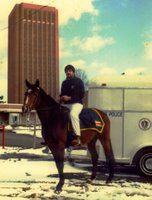
This is where I first met John, who worked behind the counter in the I/O room, in a job that is probably all but extinct these days. John was a shift operator that semester at the computing center, responsible mostly for I/O operations. You might have found him in the back loading tapes and punch cards for researchers. Often at other times, he would be out front sorting printouts from monsterous character printers - black machines with massive inked rolls that would stamp 140 characters one line at time on unending tractor-fed streams of wide, green and white-lined paper.

Walking into the I/O room, you couldn't ignore that behind the printers, was a huge printout picture of the San Francisco bay bridge which covered most of the entire wall, as well as a publicity photo of Leonard Nimoy donning a familiar tunic and pointed ears, holding a model of the Starship Enterprise. Most students would pick up their printouts and continue on with their day. Geeks like me stopped and noticed that the pictures had been printed from the same character printers we were using to list our programs and output - they couldn't print pictures as we take for granted today. I asked John how creating pictures on the batch printers was possible, and he told me the details about how the text files included special characters to tell the print tractors not to advance at certain points so that the printer bar would overstrike on certain lines, turning each character into a crude picture element. I immediately asked him if the files were available because I wanted to print copies for myself. He said he couldn't tell me because of the amount of printer time and ink-roll it would use. If the shift operators saw a poster being printed, they would delete the print job from the console and warn the user about system resource abuse. Without pause, John reached under the counter that seperated us and placed a large folded printout in front of me labelled "Spock", and pushed it towards me. I looked at the printout, which was clearly the same poster on the wall, looked at John, and began to ask, "I thought you said that no one could...", to which John interrupted me with a wide-eyed devilish grin and yelled "OOPS!" for all to hear as he covered up the printout with both hands.

Little did I know at the time that over the next twenty-plus years, John would continue to appear in my life, and that we would share many laughs, as late as this past July.

Harmless technical mischief for the sake of connecting with someone, having a good laugh, and helping anyone were some of John's signature characteristics. Part MacGyver, a little bit Loki, and possibly seperated at birth from Alton Brown, John Ponte would make it his goal to find fun and humor in just about any situtation as a means of counterbalancing a world that offered far too little of it.

Twenty years ago, John was a character no different than any outgoing person. During this time we were a group of students from around the country on our own and finding our identities, living the last phases of our formative years away from the nest. College does that to people as they pick which forks in their roads to take. John was an important mile marker. For many of us who knew him then, John was a person we would have liked to have had in our lives at least five years before we met him. In a world that was beginning to teach the harder lessons of adult responsibilities, John reminded us that it was ok to have fun while we finished growing up, and would later remind so many of us that fun is for grown-ups. John's antics on the surface were thematically no different than any other form of benevolent mischief, but at their core was a desire to learn more about the world around us, through the simplest of materials and circumstances. For some of us, this meant truly appreciating the value of a milk crate, almost to the point of mimicing the great Tulip Mania of the early 17th century. For others it meant being yanked out of bed at 4am and being stuffed into a blue Dodge Charger and driving 90 minutes to watch a sunrise. For still others it meant being affectionately identified in a crowded room as "Baghead!" with complete absense of concern for the confusion this might cause others in the audible vicinity. This would be a trait that would only become more endearing as the years would go by, at least for me. John would call me out of the blue, especially if we hadn't talked in close to a year. On more than one occasion, I would receive an unidentified call that I would take in my office on speakerphone, usually in the presence of my managers or even some of the company executives, who would turn around and wonder why my name was "Yo, Baghead!"

With the passage of time, people move to different parts of the world, pursue careers, change careers, raise families, and become centers of new social clusters. Inseperable friends of the old days lose touch with each other as the demands of day to day living pull our focus to the here and now, and the uncertain future ahead. John pursued his own life as did those of us who knew him, but with an important exception. John made it a point to stay in touch with almost everyone he developed a friendship, and help them along in his own way no matter how much time might have passed between contacts. If a new child arrived in the lives of older friends, John would humorously threaten and send gifts that would influence the family for years to come, such as an introductory installment to the Captain Underpants collection. If friends would visit him in Colorado, he would take them to dinner at the Trail Dust, and insist that the adults go to the second floor and ride the huge slides down to the main floor to show the kids how it was done. If you had car problems and John found out about it, you'd receive instructions to purchase the appropriate Chilton's and Haynes guides (even for Fiats), followed by remote help from John in diagnosing the problems you were having so that you weren't taken for a ride by your local mechanic or dealership. Even as late as July of this year, I was fortunate to get John's help in helping to diagnose a serious engine leak and determine that I had not blown a head gasket, and should avoid recommendations to replace the engine on the presumption that the head gasket was bad.

For many people that John touched, he acted as a social lubricant. But a funny thing can happen to lubricants as they stay in contact with surfaces over time - they can sometimes start to act like glue. The news of John's passing has shed momentary light on the sheer scale of how much John influenced many people's lives, and in a heartbeat, has brought people back together that haven't seen each other in over a decade or more. It has also shown us that right up until his passing, John's selfless desire to help people with humor and knowledge (often a mix of the two) had not changed.

John's life was not devoid of challenges. It is very likely that much of John's approach to life was a response to those challenges. The irony of this circumstance is unpalatable only if we let John's influences pass with him. Twenty years from now, or even two hundred years from now, you, the reader may be staring at these words, and possibly follow the embedded links and read archives of the referenced articles and sites, and wonder who John Ponte was. I encourage your curiousity.

It may not ever be possible to know just how many people John touched in his life or how far his influences will resonate through following generations.

One thing is certain, the world is a better place, because John Ponte was in it.